Small Form-factor Pluggable (SFP), or mini-GBIC (gigabit interface converter) module is a compact, hot-swappable transceiver used for both telecommunication and data communication applications.
The MSA ensures that SFP modules from different vendors are compatible with each other, as long as they are compliant with the agreement.
Is important to know several key points or we can help to choose the right module...
MMF or Multi Mode Fiber and SMF or Single Mode Fiber. Should I run SMF o MMF?
SFP modules provide networks the ability to convert Ethernet signals to fiber optic signals without having to change the networking switch or router. It saves the customers the need to replace or upgrade any networking or cabling infrastructure.
In 2006, SFP+ specification brought speeds up to 10 Gbps called “enhanced” small form-factor pluggable, the SFP+ transceivers are compatible with managed media converters and Ethernet switch products to meet specific networking protocols and media requirements.
The XFP (10 gigabit small form-factor pluggable) is a standard for transceivers for high-speed computer network and telecommunication links that use optical fiber.
10G SFP+ optics has a smaller footprint than the XFP modules, which can also enable greater port density.
SFP28 stands for Small Form-Factor Pluggable 28. It is a third-generation SFP connection system built for 25G throughput per IEEE 802.3 by specification (25GBASE-CR). SFP28 is an improved version of SFP+, designed for 25Gbps signal transmission.
Quad Small Form-Factor Pluggable Plus, is a parallel and hot swappable fiber optical module that provides high-density 40Gbps connectivity options for high-performance networks, datacenters, etc.
Quad Small Form-Factor Pluggable 28, these transceivers are suitable for 100 Gigabit Ethernet , EDR InfiniBand or 32G Fiber Channel Networks.
The QSFP56 (Quad Small Form-Factor Pluggable 56) Optical Transceiver is a module designed to support high-speed communication networks.
As the demand for bandwidth grows, the need to the single lane speed in a QSFP is now coming to 112Gbps.
QSFP-DD is a new module and cage/connector system similar to current QSFP, but with an additional row of contacts providing for an eight lane electrical interface. It is being developed by the QSFP-DD MSA as a key part of the industry’s effort to enable high-speed solutions.
The OSFP is a new pluggable form factor with eight high speed electrical lanes that will initially support 400 Gbps (8x50G). It is slightly wider and deeper than the QSFP but it still supports 36 OSFP ports per 1U front panel, enabling 14.4 Tbps per 1U.
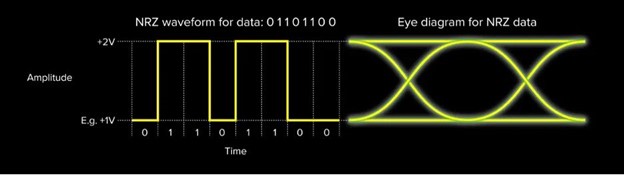
Optical modulation allows one to control an optical wave or to encode information on a carrier optical wave. The inverse process that recovers the encoded information is demodulation. There are many types of optical modulation, which can be categorized in several different ways.
NRZ Modulation and PAM 4 Modulation
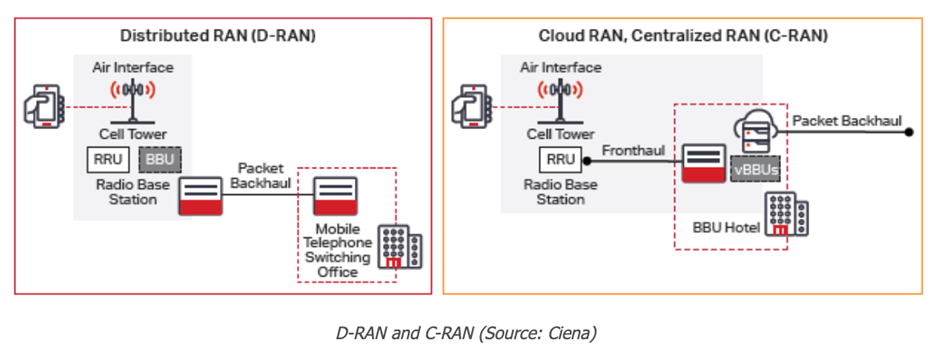
CPRI is an open specification for an interface between Radio Equipment Controllers (REC) often referred to as BBU, and Radio Equipment (RE), often referred to as RRH.
D-RAN is the traditional RAN or Radio Access Network where BBU (Baseband Unit) and RRH (Remote Radio Head) are placed on the same place in the site. C-RAN is the decoupling between BBU and RRH, Where BBU is moved to the data center to be centralized to manage different RRHs through Fronthaul Common Public Radio Interface (CPRI).
DWDM transceivers with a fixed wavelength are ideally suited for operation within the band of a specific wavelength. They are preferably used in static networks in which no changes are expected in the future.
ATOP develops 1.6T silicon optical modules and 800G 2*FR4 silicon optical modules based on Intel 200G Per Lane PIC, providing solutions for next-generation AI applications and high-speed data center networks.
Learn why a Powell lens is the most effective way to transform a Gaussian laser beam into a uniform line.